
Insight · Field note
What a flood
response looks
like thirty
days in
The first week of a disaster is well covered by everybody. The fourth week is not, and the fourth week is where the outcome is actually decided.
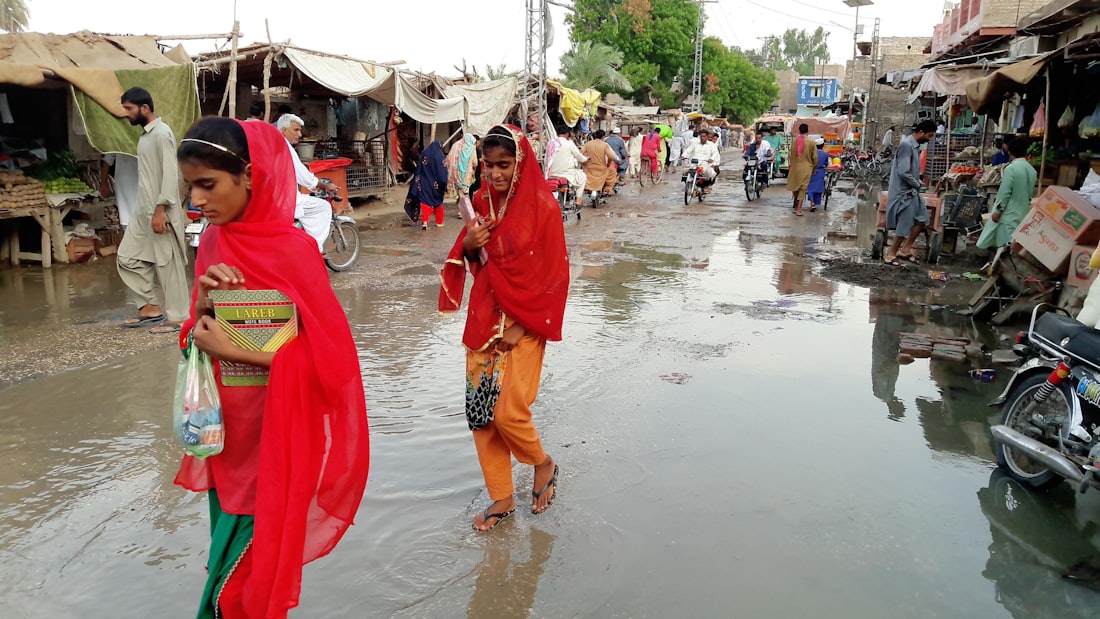
Pakistan's 2022 monsoon floods produced the best-documented climate disaster in the country's history. The post-disaster assessment is unusually good. What it exposes is not a failure of response, but a structural gap in what response is designed to cover.
The headline figures are familiar. A third of a country under water; 33 million people affected; more than 1,730 dead; over 8 million displaced.12 The joint Post-Disaster Needs Assessment, led by Pakistan's Ministry of Planning with the World Bank, ADB, EU and UN, put damages at USD 14.9 billion, economic losses at USD 15.2 billion, and reconstruction needs at at least USD 16.3 billion.1
Those are the numbers that were reported. The numbers that were not reported are the ones that decide what the following six months look like.
The population inside the population
Of the 33 million people affected, an estimated 8.2 million were women of reproductive age, and UNFPA estimated that around 650,000 were pregnant and required maternal health services to reach a safe delivery.34
Both groups have needs that do not pause for a disaster and do not appear in a shelter count. A woman menstruating in a displacement site needs a product, water, privacy and somewhere to dispose of it. If the response supplies food, water and shelter but not those four things, she is not being served. She is being counted.
Figure 1
Scale of need versus scale of early menstrual and dignity provision
Why week four is the one that matters
Emergency response is optimised, correctly, for the first seventy-two hours: search and rescue, water, food, shelter. That machinery works, and it is not what we are criticising.
The problem is what happens when the cameras leave and the water does not. More than 8 million displaced people faced a health crisis precisely because floodwater remained stagnant, conditions in which water-borne and vector-borne disease spread.2 Stagnation is a month-scale phenomenon, not a week-scale one. So is the hygiene failure that accompanies it.
Sanitation and menstrual provision are treated as secondary right up until they become the reason people are ill.
By week four, three things have usually happened at once. The acute response is winding down. The longer-term programming has not started, because it is contracted separately, funded separately and frequently delivered by a different organisation. And the population has begun making the decisions about school, about work and about moving that will define the next several years for them.
That gap between response and programming is not an accident of any one disaster. It is how the sector is structured. And it is the single most reliable place to lose a population.
What we design differently
We plan the first thirty days and the following twelve months as one programme, not two, with three specific consequences.
- Hygiene and menstrual provision belong in the 72-hour plan. Not the recovery plan. The cost of including them early is trivial; the cost of retrofitting them at week six is a health caseload.
- What is set up in week one is what continues in month six. Same local partners, same distribution points, same people. A handover between organisations is a point of failure, so we design to avoid needing one.
- The baseline is taken during the response, not after it. This is operationally inconvenient and methodologically decisive. Reconstructing a pre-flood baseline six months later produces a number nobody should rely on.
Our reported indicator for this work is households reached with hygiene and water provision within 30 days, mapped to SDG target 13.1 on resilience and adaptive capacity to climate hazards. Thirty days is not an arbitrary threshold. It is roughly the point at which a displaced household's situation stops being an emergency and starts being a condition.
This is now a recurring design problem
2022 is treated as an exceptional year. It should not be. Pakistan sits in the group of countries most exposed to climate hazard while holding among the fewest resources to absorb it, and the loss fell hardest on the poorest districts. Sindh alone carried close to 70% of total damages and losses.1
An organisation that treats flood response as an exception will rebuild the same gap every time. An organisation that treats it as a recurring condition designs for the fourth week from the beginning, and keeps the local delivery capability standing between events, rather than assembling it under pressure each time it is needed.
Sources
- Government of Pakistan, Asian Development Bank, European Union, United Nations, World Bank. Pakistan Floods 2022: Post-Disaster Needs Assessment, October 2022.
- UNDP. Pakistan: Flood damages and economic losses over USD 30 billion.
- UNFPA Pakistan. Women and girls bearing the brunt of the Pakistan monsoon floods.
- UNFPA. Women and girls in Pakistan need urgent health and protection services amid epic flood disaster.
- ILO. Pakistan Floods 2022: Post-Disaster Needs Assessment, main report.
How we design for this
Scope, Design, Deliver, Measure, Verify, with the baseline established before delivery begins, including in an emergency.