
Insight · Field note
The school days
nobody counts
An attendance register records that a girl was absent. It does not record why. The monthly pattern that would make the cause obvious is invisible unless somebody goes looking for it, and almost nobody does.
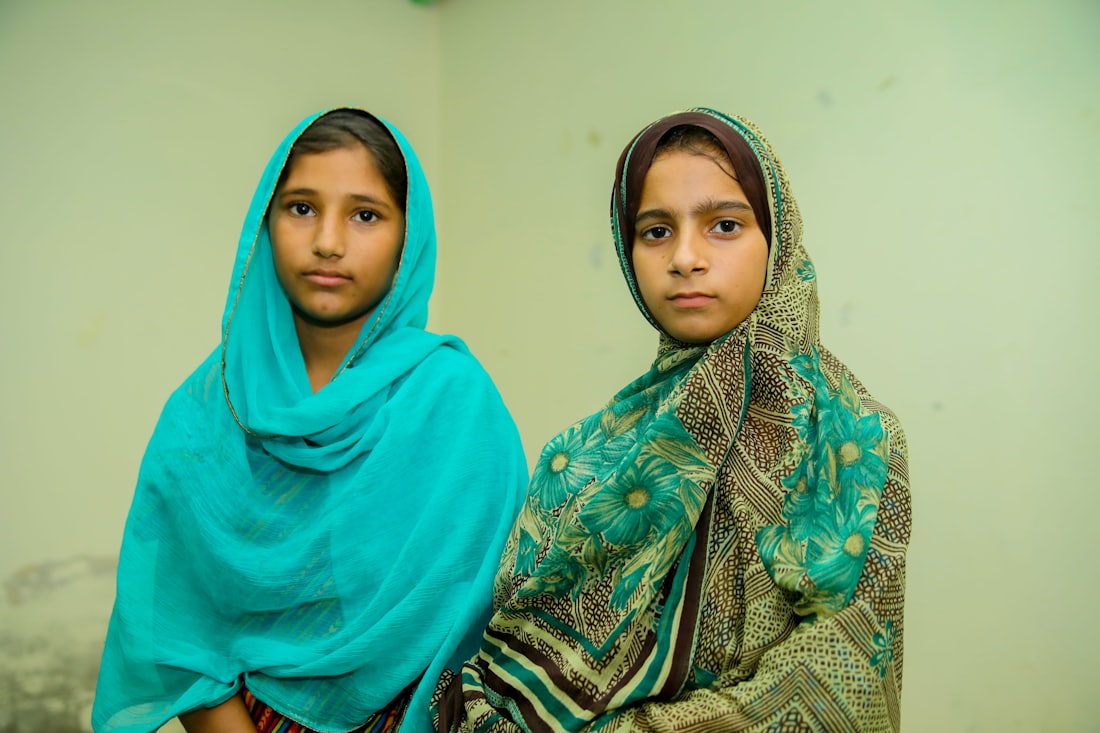
In one district of rural Sindh, three quarters of adolescent girls and young women manage their periods with materials that no health authority would call adequate. Just over a fifth of the students among them stay home while menstruating. Neither fact appears in any education statistic.
The largest study of menstrual hygiene management practice in rural Pakistan surveyed 25,305 adolescent and young women aged 15 to 23 in Matiari district, Sindh, between June 2017 and July 2018.1 It is worth dwelling on that sample size. Most of what circulates about menstrual health in Pakistan rests on qualitative work with a few hundred participants. This is a district-scale census of practice, and it is unambiguous.
Figure 1
What women and girls in Matiari district actually use
Twelve point six per cent used nothing at all. That is roughly 3,190 women in a single district, and it is the number that should reorganise how a programme is designed, because it describes a group for whom the intervention is not an upgrade. It is a first.
Cost is the binding constraint, and it is not close
When the same women were asked why they did not use sanitary pads, the answer was overwhelmingly economic rather than cultural. This matters, because programmes are routinely designed around the assumption that the barrier is taboo, and are therefore weighted towards awareness-raising.
Awareness is the smallest of the four. An awareness campaign in this district, run on its own, would be addressing the constraint that binds least, while the constraint that binds most, price, went untouched. This is the most common design error we see in menstrual health programming, and it is expensive precisely because it produces activity that looks like progress.
The multivariate analysis makes the economic reading harder still to avoid. Women in the lowest wealth quintile had 4.41 times the odds of inadequate practice; those with no formal education, 3.9 times; those with poor handwashing practice, 3.12 times.1 Poverty, education and water access are not three separate problems here. They are one problem observed from three angles.
The absence nobody records
Among the 2,147 respondents who were regular students, 22.2% said they did not attend school while menstruating.1 Set that against the physical infrastructure they are expected to attend: around one in three Pakistani schools lacks basic toilet provision, and in a national WASH-in-schools assessment 16% of sampled schools had no water, sanitation or hygiene service at all.23
A girl is not choosing to miss school. The building is telling her to go home.
Now do the arithmetic that education statistics do not. A girl menstruating for three days a month across a nine-month school year loses on the order of 27 school days, most of a full academic month, every year, invisibly, and concentrated among exactly the girls least able to absorb the loss. The register shows a scattering of single-day absences. It does not show that they fall in a monthly rhythm.
What we do about it, and how we measure it
The unit of measurement most programmes report is products distributed. It is easy to count, auditable at the point of handover, and almost meaningless. It records a transaction, not a change.
The unit we report is school days retained per participant per cycle, established against a pre-intervention baseline. It is harder to collect and it is the only figure that answers the question the programme actually exists to answer.
How the instrument works
- Baseline at intake. Self-reported attendance during the previous three cycles, collected before any product or education is delivered.
- Register cross-check. Recall is cross-referenced against the school attendance record for the same period. Recall alone overstates; registers alone miss the reason. Neither source is sufficient on its own, and we report where they diverge rather than picking the flattering one.
- Endline at a fixed interval. Same instrument, same participants, same three-cycle window, so the comparison is like for like.
- Attrition published as a number. Participants lost between intake and endline are reported as a count and a proportion, not quietly excluded from the denominator.
Where no comparison group is feasible, which at district scale and on this timeline is usually the case, we say so explicitly and report the measured change without claiming that our programme caused all of it. Other things happen in a district during a school year. A result that pretends otherwise is not a stronger result; it is a less honest one.
What this changes about design
Three consequences follow from the data, and all three are uncomfortable for the standard programme template.
Price is the intervention. If half your target population cites cost, a product that is merely available has not solved anything. The design question is whether the product is free at the point of use, subsidised, or genuinely affordable at local income, and that has to be settled before procurement, not after.
Water is a precondition, not a nice-to-have. Reusable products require washing and private drying. In a school with no water service, a reusable product is a worse option than a disposable one, whatever its environmental profile. The WASH status of each site belongs in the site selection criteria.
Education without product changes nothing, and product without education changes little. The 12.6% using nothing at all are not short of information. They are short of a pad. Equally, a pad handed to a girl who has been told nothing about what to do with it is a logistics number in search of an outcome.
None of this is complicated. It is simply what the data says, as opposed to what the sector's habits assume.
Sources
- Michael J, Iqbal Q, Haider S, et al. Practices and predictors of menstrual hygiene management material use among adolescent and young women in rural Pakistan: a cross-sectional assessment. Journal of Global Health, 2022. n = 25,305, Matiari district, Sindh; data collected June 2017 – July 2018.
- WaterAid Pakistan. Bringing back hope through WASH in Schools.
- SuSanA. Country Snapshot Pakistan: WASH in Schools overview, 2018–2020 update.
- UNICEF Pakistan. Menstrual hygiene.
- Ahmed S, et al. Serious absenteeism amongst Pakistani school and university girls during menstruation. The Lancet Regional Health – Southeast Asia, 2022.
The programme this comes from
Maahwari delivers eco-friendly menstrual products and structured health education together, then follows up to find out whether the products are still in use.