
Insight · Field note
A flood does not
create period
poverty
It removes the three things that were quietly holding an already fragile practice together: water, privacy and somewhere to dry. All of them go at once, and what was survivable on Monday is a health risk by Friday.
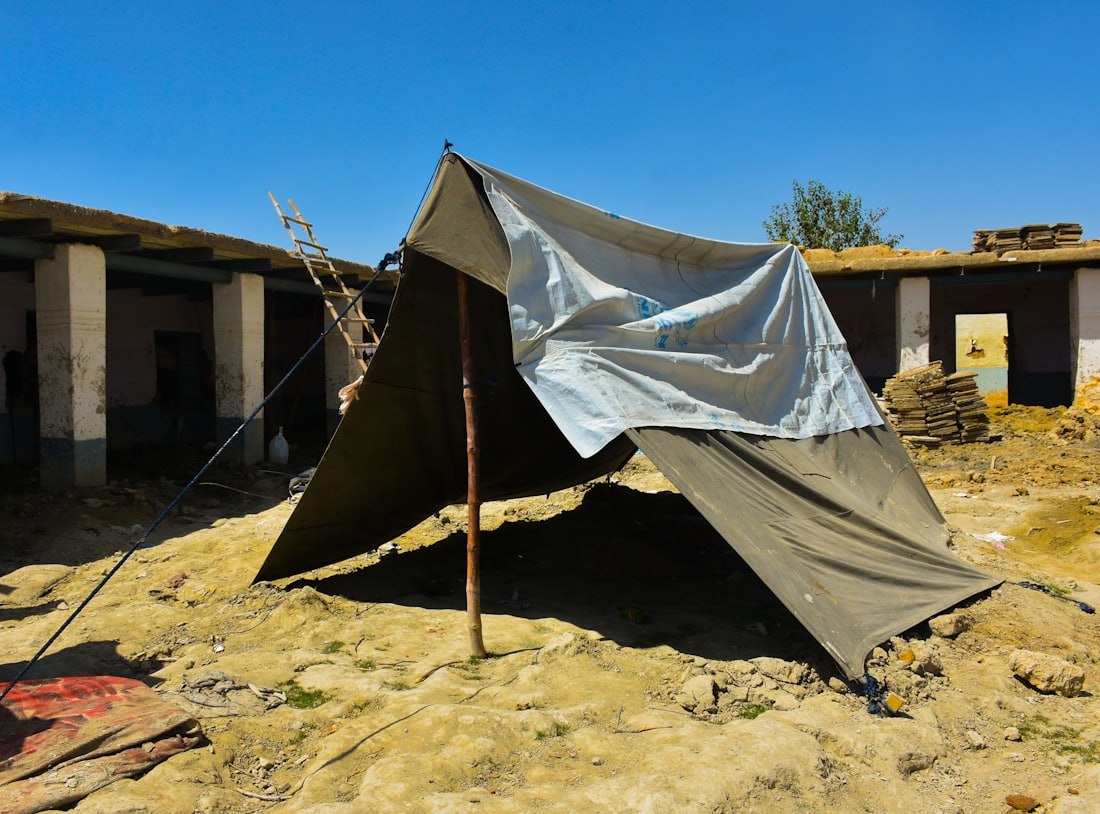
Period poverty is usually described as a lack of products. In a displacement setting that framing is actively misleading, and it produces responses that distribute the right thing into conditions where it cannot be used.
The practice that was already fragile
Start with what was true before the water arrived. In the largest study of menstrual hygiene practice in rural Pakistan, covering 25,305 women in Matiari district, Sindh, found that 61.9% were using old cloth and 12.6% were using nothing at all. Cost was the barrier to sanitary pads for 48.7% of them.1
Using cloth is not, in itself, unsafe. Done properly it is a reasonable practice with a long history. But it is conditional in a way disposables are not. Cloth has to be washed in clean water, dried fully, ideally in sunlight, and stored somewhere dry and private. Remove any one of those and the same cloth becomes a vector rather than a solution.
So the pre-flood position in rural Sindh was not "women are coping". It was: a majority were using a method whose safety depended entirely on infrastructure and privacy that were already marginal.
What displacement removes, and how fast
A flood does not degrade those three preconditions gradually. It removes all of them simultaneously, in the same hour.
Figure 1
The preconditions cloth-based menstrual management depends on
| Precondition | Normal conditions, rural Sindh | Displacement site |
|---|---|---|
| Clean water to wash | Marginal: constrained, often distant | Absent; standing floodwater is contaminated |
| Private space to dry | Limited: courtyard, out of view | Absent; drying in view is not acceptable |
| Dry, private storage | Available in the household | Absent |
| A private place to change | The home | Shared latrine, frequently mixed-sex |
Research across four flood-affected districts (Swat in Khyber Pakhtunkhwa, Khairpur in Sindh, and Muzaffargarh and Rajanpur in South Punjab) documented women falling back on rags and, in some cases, leaves, with no private or hygienic area to change or dispose of anything.2
Waiting for nightfall
Two findings from that literature describe the privacy problem more precisely than any general statement about dignity could.
The first: in flood relief camps, 95% of women reported using the same toilet as men, because there was a single latrine.3
The second: women reported waiting until night to go and change.2
A woman changing once a day, after dark, because it is the only moment she is unobserved.
That is the operative fact. Not "insufficient facilities" but a specific behaviour, with a specific medical consequence, produced by a specific design failure in how camps get built.
What that produces medically
Extended wear of an unclean or saturated material, in heat, without washing, is a well-characterised clinical risk. The documented consequences among flood-affected women in Pakistan include reproductive tract infections, bacterial vaginosis and candidiasis, urinary tract infections, and pelvic inflammatory disease, with associated risk of premature labour, in a population that included an estimated 650,000 pregnant women.2345
Set the first and last of those figures beside each other and the shape of the response gap is visible without further commentary. Early procurement by one agency is not the whole response, and more was distributed later, but the opening weeks are precisely when the practice that causes the infections gets established.
Why this keeps happening
The academic literature is blunt about the cause: menstrual hygiene management "remains a neglected part of the disaster response system in Pakistan because it often gets overshadowed by other immediate relief activities".3
We would put it slightly differently. It is not overshadowed because anyone thinks it unimportant. It is overshadowed because response is triaged by visible mortality risk, menstrual health is not a visible mortality risk in week one, and by week three, when the infections present, the procurement decisions have already been made and the trucks are already loaded.
It is a sequencing failure, not a values failure. Which is good news, because sequencing is fixable.
What we design differently
MHM belongs in the 72-hour plan
Not the recovery plan. The marginal cost of including menstrual provision in an initial procurement is small. The cost of adding it at week six is a clinical caseload in a population with almost no access to gynaecological care.
The product choice inverts, and this is where we contradict ourselves on purpose
We have argued at length that reusable products are the right answer for menstrual programming, and that the environmental case for them is strong. In acute displacement that argument reverses.
A reusable product requires washing, private drying and dry storage. Those are exactly the three things a displacement site does not have. Distributing reusables into an acute-phase camp is distributing an object that cannot be used safely, and doing it while reporting waste displaced would be worse than useless.
In the acute phase the correct product is disposable, supplied with a disposal route. The transition back to reusables belongs at the point where water and privacy are restored, and that transition should be planned rather than assumed.
Facilities are the intervention, not the accessory
Women-only WASH facilities with a lock and lighting change more than product distribution does. That is the consistent recommendation in the literature2 and it matches what we see: the constraint that produced "waiting for nightfall" is a door that locks, not a pad.
Female workers, and the people who decide
Deploying female health and distribution workers is a precondition for anything being asked for at all, given the reporting reluctance the same research documents. Engaging community and religious leaders is what makes provision acceptable rather than merely available.2
What we measure
Our reported indicator for this work is households reached with hygiene and water provision within 30 days, mapped to SDG target 13.1, alongside sustained access at follow-up under target 6.2, the target that names the needs of women and girls explicitly.
Two measurement notes specific to disaster settings, both learned the hard way:
- Take the baseline during the response. It is operationally inconvenient and it is the only chance you get. A pre-flood baseline reconstructed six months later is a number nobody should rely on.
- Report the facility, not just the kit. Products distributed without a private, lockable place to use them should be reported as products distributed, not as access provided. Those are different claims and only one of them is about an outcome.
The point of the whole argument
If you believe period poverty is a product shortage, a flood looks like a spike in demand and the response is a bigger truck.
If you understand it as a dependency on water, privacy and space, a flood looks like the simultaneous removal of three preconditions, and the response is water points, lockable latrines with lights, female staff, and a product appropriate to conditions that will change again in six months.
The second reading costs about the same. It just produces a materially different programme, and one whose results are still standing when somebody comes to check them.
Sources
- Michael J, Iqbal Q, Haider S, et al. Practices and predictors of menstrual hygiene management material use among adolescent and young women in rural Pakistan. Journal of Global Health, 2022. n = 25,305, Matiari district, Sindh.
- Integrating menstrual hygiene management (MHM) in disaster health response: lessons from the 2022 Pakistan floods. Environmental Research: Health. Focus groups and expert interviews across Swat, Khairpur, Muzaffargarh and Rajanpur.
- Menstrual hygiene management in flood-affected Pakistan: addressing challenges and ensuring women's health and dignity. Frontiers in Global Women's Health, 2023.
- WaterAid. Women and girls in Pakistan's flood zone suffering urinary tract infections and reproductive complications.
- UNFPA Pakistan. Women and girls bearing the brunt of the Pakistan monsoon floods, 8.2 million women of reproductive age, an estimated 650,000 pregnant, and early dignity kit procurement.
- Managing menstruation during natural disasters: MHM during the "super floods" in Sindh province. Journal of Biosocial Science.
Where this work sits
Maahwari and our climate resilience programmes are designed as one thing, so that what is set up in week one is what continues in month six.